
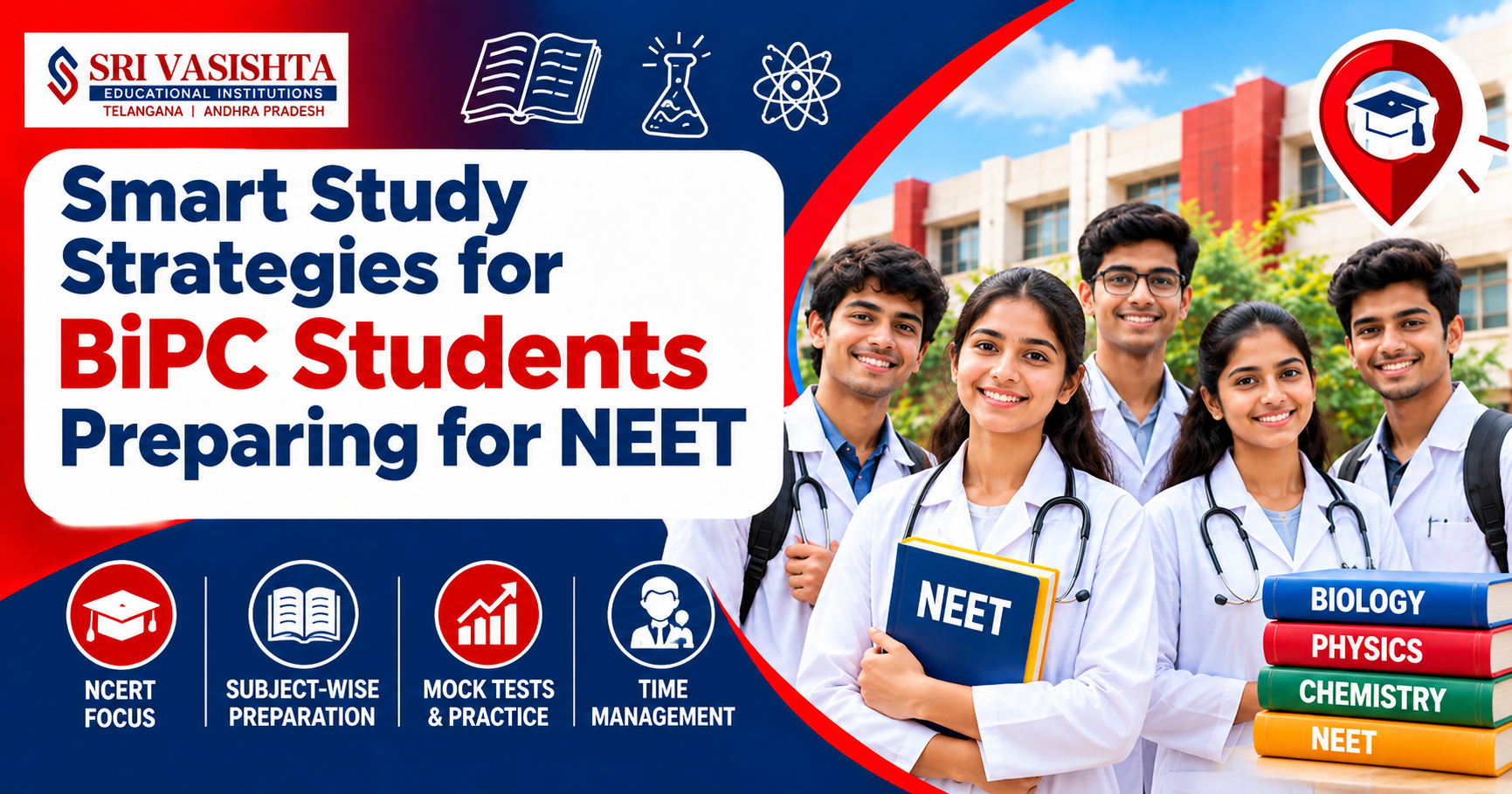
Smart Study Strategies for BiPC Students Preparing for NEET
Enquiry Now
Our Courses
Student Testimonials
Recent Blog Posts
-
 How to Find A Junior College Near Me With Good Education ?
-
 Benefits of Integrated BIPC & NEET Coaching
-
 How Top Junior Colleges in Hyderabad Shape Student Growth
-
 How to Choose the Right Intermediate College in Hyderabad After Class 10
-
 Smart Study Strategies for BiPC Students Preparing for NEET
-
 Best Intermediate College In Dilsukhnagar Hyderabad
-
 Top BiPC Colleges in Hyderabad
-
 How to Balance Board Exams and JEE Preparation
-
 TS EAMCET vs JEE: Which Entrance Exam Should MPC Students Choose?
-
 BiPC with NEET Coaching in Hyderabad
Follow Us
Conclusion
Preparing for NEET is an important step for BiPC students who dream of becoming doctors. However, balancing Intermediate studies with competitive examination preparation can sometimes feel challenging. Biology, Physics and Chemistry require different learning approaches, and students need a proper study plan to manage all three subjects effectively.
The secret to successful NEET preparation for BiPC students is not studying for endless hours. It is about understanding concepts, practising questions regularly, revising important topics and improving performance through consistent effort.
With the right strategies and academic guidance, students can make their preparation more organised and productive.
Understand the NEET Syllabus Before Starting
Before beginning your preparation, download the official NEET syllabus and divide it into individual chapters. Review each topic carefully to understand which concepts you already know and which areas need additional attention.
To monitor your progress, create a simple checklist for every chapter. Mark topics as completed, under revision or pending. This organised approach helps you stay focused and ensures systematic syllabus coverage.
Start by downloading the official syllabus and dividing it into individual chapters. Identify the topics you already understand and the chapters that require additional attention.
Create a checklist to track your progress. Mark each chapter as completed, under revision or pending. This simple method helps you stay focused and ensures that you cover the entire syllabus systematically.
Make NCERT Textbooks Your Primary Study Resource
NCERT textbooks are essential for NEET preparation for BiPC students. Students should build strong conceptual knowledge using their prescribed textbooks before moving on to additional reference materials.
Biology requires particular attention to definitions, diagrams, examples and scientific terminology. Chemistry also includes several topics where understanding textbook concepts is important.
Follow these techniques:
- Read NCERT chapters carefully.
- Highlight important definitions and concepts.
- Prepare short notes for difficult topics.
- Practise textbook-based MCQs.
- Revise diagrams, tables and examples regularly.
Avoid collecting too many reference books. Concentrate on a few reliable resources and revise them consistently.
Follow a Subject-Wise Study Strategy
Every subject requires a different preparation approach. Therefore, giving equal importance to Biology, Physics and Chemistry is essential for achieving a good overall NEET score. Focusing on only one subject while neglecting the others can affect your examination performance.
Biology: Focus on Concepts and Revision
Biology is an important scoring subject for NEET aspirants. Students should develop a strong understanding of Botany and Zoology through regular reading and practice.
To improve Biology preparation, follow these techniques:
Read NCERT Biology line by line.
Practise labelling important diagrams.
Create flowcharts for biological processes.
Memorise terminology through active recall.
Solve chapter-wise MCQs after studying each topic.
Additionally, give special attention to topics such as Human Physiology, Genetics, Ecology and Plant Physiology.
Physics: Practise Numerical Problems Daily
Physics can be challenging for students who are more comfortable with theoretical subjects. However, regular numerical practice can gradually improve problem-solving skills and confidence.
Start by understanding fundamental concepts before memorising formulas. For better preparation, maintain a separate formula notebook and practise different types of problems.
Begin with basic questions and gradually move towards application-based problems. Moreover, review incorrect answers to understand calculation mistakes and improve accuracy.
Chemistry: Balance Theory and Practice
Chemistry includes Physical, Organic and Inorganic Chemistry. Similarly, each section requires a different learning technique to develop strong conceptual understanding.
Section | Study Strategy |
|---|---|
Physical Chemistry | Practise formulas and numerical problems. |
Organic Chemistry | Understand reaction mechanisms and conversions. |
Inorganic Chemistry | Revise NCERT concepts, trends and reactions. |
Finally, regular revision helps students retain important concepts and apply their knowledge confidently during examinations.
Create a Realistic Daily NEET Study Timetable
A proper timetable helps NEET preparation for BiPC students balance Intermediate classes, NEET coaching, assignments and self-study.
Instead of following an extremely demanding schedule, create a routine that you can maintain consistently.
Here is an example:
Time | Study Activity |
6:00 AM – 7:00 AM | Biology revision |
College Hours | Intermediate classes and NEET coaching |
4:00 PM – 5:00 PM | Physics practice |
5:00 PM – 5:30 PM | Break |
5:30 PM – 6:30 PM | Chemistry preparation |
6:30 PM – 7:30 PM | Biology MCQs |
8:30 PM – 9:30 PM | Revision and error analysis |
Adjust the timings according to your college schedule and learning requirements.
The objective is to maintain a balance between learning new concepts, solving questions and revising previously studied topics.
Practise Mock Tests and Previous Year Questions
Understanding concepts is important, but students must also know how to apply their knowledge during the examination. Mock tests help students improve their NEET preparation for BiPC students by familiarising them with the examination pattern, question types and time limitations.
Follow these steps:
Start with chapter-wise tests after completing individual topics.
Attempt subject-wise tests to evaluate your understanding.
Gradually introduce full-length mock examinations.
Analyse incorrect and unanswered questions.
Maintain a record of recurring mistakes.
Previous year question papers are also useful for understanding question patterns and identifying topics that require more practice.
Remember, analysing your performance after every test is just as important as attempting the test itself. Consistent mock test practice and performance analysis can make NEET preparation for BiPC students more effective.
Use Active Recall and Spaced Repetition
Reading the same chapter repeatedly does not always guarantee that you will remember everything during an examination.
Active recall and spaced repetition are effective learning techniques that help improve information retention.
Active recall: Close your textbook and try to remember important concepts without referring to your notes.
Spaced repetition: Revise previously studied topics at planned intervals instead of studying them only once.
For example, revise a topic on the same day, after three days, after one week and again after two weeks.
These techniques are particularly useful for Biology terminology, Chemistry reactions, Physics formulas and important scientific concepts.
Identify Weak Areas and Improve Gradually
Every student has different academic strengths and learning abilities. For example, some students understand Biology quickly but struggle with Physics numericals, while others may find Organic Chemistry difficult. Therefore, identifying your weak areas early is essential for effective NEET preparation for BiPC students.
To begin with, identify your weak chapters and create a separate improvement plan. Divide your topics into three categories:
Strong: Topics you understand confidently.
Average: Topics requiring additional practice.
Weak: Topics needing conceptual clarification and revision.
Additionally, spend more time improving weak areas while continuing to revise your stronger topics. Whenever you encounter difficult concepts, ask teachers for clarification. As a result, you can develop better conceptual understanding instead of simply memorising solutions. Following this structured approach can make NEET preparation for BiPC students more effective and help you build confidence for the examination. Consistent practice and regular self-assessment are essential for successful NEET preparation for BiPC students.
Maintain Good Health During NEET Preparation
NEET preparation requires consistency, concentration and patience. Students should take care of their physical and mental well-being throughout the preparation period.
Maintain a regular sleep schedule, eat balanced meals, drink enough water and take short breaks between study sessions.
Walking, stretching or simple physical activities can help you feel refreshed after long study hours.
Avoid comparing your preparation progress with other students. Focus on your daily targets and celebrate small improvements.
Choose the Right BiPC With NEET Academic Guidance
Self-study plays an important role in NEET preparation, but structured academic guidance can help students understand difficult concepts, maintain discipline and evaluate their progress. Choosing the right guidance is an important part of NEET preparation for BiPC students.
Choosing an institution that supports both Intermediate education and competitive examination preparation can make learning more organised.
Sri Vasishta Educational Institutions offers a BiPC with NEET integrated program designed to support students preparing for medical entrance examinations.
Students can benefit from academic support such as:
Experienced subject faculty.
Individual student attention.
Regular assignments and assessments.
Online and offline NEET examination facilities.
Performance analysis through examination portals.
Structured academic preparation.
The right learning environment can help students build conceptual clarity, improve problem-solving skills and develop confidence. Therefore, choosing a suitable integrated program can strengthen NEET preparation for BiPC students
Planning to pursue BiPC with NEET? Explore the Sri Vasishta BiPC with NEET Program and take the next step towards your medical education goals.
FAQs:
BiPC students can prepare effectively by following a structured timetable, studying NCERT textbooks, practising daily MCQs, revising important topics and attempting regular mock tests.
There is no fixed number of study hours for every student. Follow a realistic timetable that balances college classes, self-study, revision and practice tests. Consistency is more important than simply counting hours.
NCERT textbooks provide an essential foundation for NEET preparation, particularly in Biology. Students should also practise numerical problems, MCQs and previous year question papers to strengthen their understanding.
Biology carries 360 marks in NEET, but Physics and Chemistry are equally important for achieving a strong overall score. Students should prepare all three subjects systematically.
Integrated coaching combines Intermediate education with competitive examination preparation. It provides structured learning, subject guidance, regular assessments and opportunities to practise NEET-oriented questions.